
Hopewell's Balanced Calendar: Expanding Opportunity Beyond the Bell
Hopewell's Balanced Calendar: Expanding Opportunity Beyond the Bell
By Byron Davis, Director of Strategic Initiatives, Hopewell City Public Schools
What would you do if the restraints of tradition were lifted? How would you design instruction? Those questions led Hopewell City Public Schools to create something Virginia had never seen before, a division-wide Balanced Calendar program that has fundamentally changed what school means for students in a small urban community.
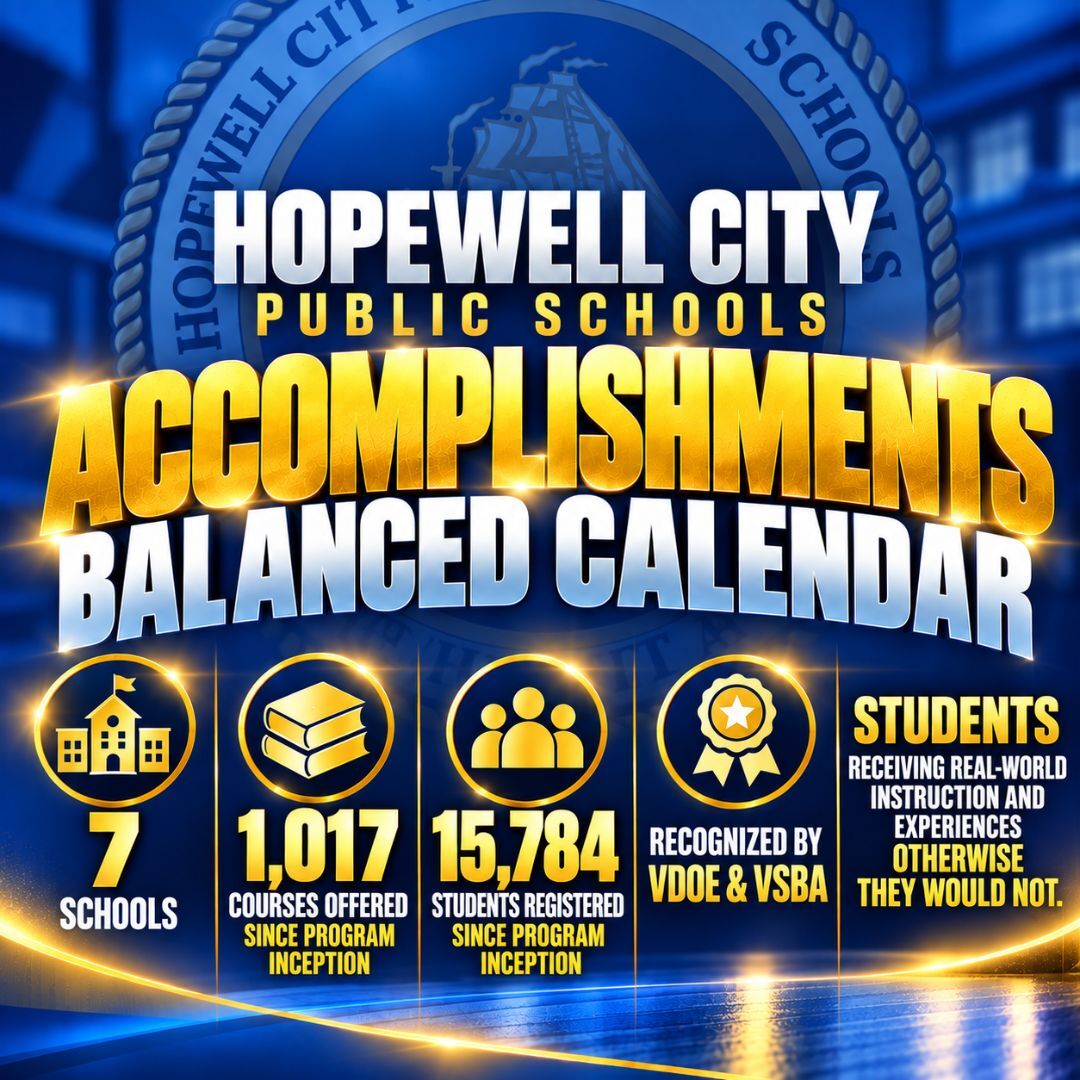
Hopewell City Public Schools serves approximately 4,000 students across seven schools. When the Balanced Calendar launched in the 2021–2022 school year, the goal was clear and deliberate: provide up to 30 additional days of potential schooling per year to ensure safety, structure, food, and access to enrichment and real-world experiences for students who might otherwise go without. For a community where limited resources restrict opportunity, that mission has proven meaningful.
The calendar itself reorganizes the traditional school year, starting in late July but maintaining the state-required 180 days, and adds six weeks of intersession programming: two weeks in October, two in late February, and two in mid-June. Since launch, the program has generated over 1,000 unique course offerings and nearly 16,000 student registrations. From college visits and entrepreneurial courses to cooking classes, swimming, overnight camps, and targeted academic support, the breadth of what students can access is genuinely remarkable.
What makes this model distinctive is not a top-down curriculum mandate but the opposite. Teachers design and submit their own courses. Building administrators identify their school's specific needs and approve offerings accordingly. The result is a program animated by individual passion and professional ownership rather than compliance. Every teacher becomes a potential innovator.
Strategic framing also mattered. Year-round school carries cultural baggage, families often assume it means less flexibility or a greater burden. Hopewell deliberately chose different language and invested in helping stakeholders understand how the model actually works and what choice looks like within it. One intersession week is built into teacher contracts, ensuring baseline participation division-wide. Beyond that, additional participation is compensated, giving teachers genuine agency over their time while keeping the program alive and staffed.
Hopewell has produced unforgettable experiences with unique and innovative courses. Collaborative partnerships have led to greater opportunities. The local recreation center has provided facilities and support for students to learn to swim. There have been courses in collaboration with the local police, helping students to make good and safe decisions. The local Moose lodge has provided a facility for students to have cooking courses. There have been theater productions, gymnastics, and dance performances. There has been archery, leadership training, and overnight camping trips. There has been art and poetry, and there have been targeted remedial courses that have allowed students to demonstrate mastery requirements necessary for promotion.
The Balanced Calendar is now part of Hopewell's identity. It represents a conviction that schools can be more than a building open 180 days a year, that they can be anchors of stability, access, and possibility in the life of a community.